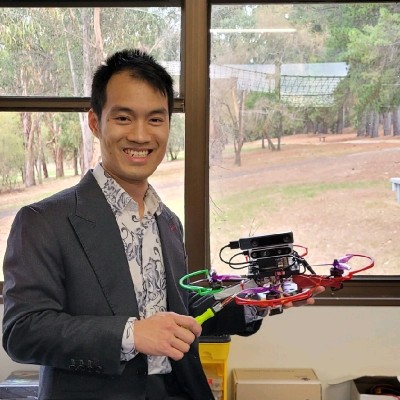
About
Binh Nguyen is a Robotics Scientist and Tech Lead with over ten years of experience across aerospace, defence, and commercial robotics, building safety-critical autonomous platforms from concept through deployment. His end-to-end technical leadership spans perception, planning, control, and digital-twin infrastructure, with a track record of leading multidisciplinary teams to deliver resilient autonomous systems.
He is currently building a resilient Autonomy Stack for Space Security with SMC.
 Education
Doctor of Philosophy | Robotics & AI
Federation University Australia, Churchill, Victoria, Australia
May 2022 – Oct 2025
Thesis recommended for a Dean’s Excellence Award by an independent external examiner. [Thesis] [Examiner Report]
Bachelor of Engineering (Honours) | Electronics & Communication Engineering
Hanoi University of Science and Technology (HUST), Hanoi, Vietnam
2012 – 2017
#1 in Vietnam during 2012–2018 by Scimago Institutions Rankings.
 Experience
Principal Flight Software Engineer @ Space Machines Company
-
Leading flight software development for Optimus Viper, a Rapid Response Vehicle for Autonomous Proximity Operations:
- Researched and proposed a new architecture for the flight software stack to better host safety-critical maneuvers and enable over-the-air update without interrupting service: an asymmetric multiprocessing (AMP) split on a SoC, running RTOS on an isolated core for the safety-critical control loop alongside custom Linux on the remaining cores for ground communication and payload, with cross-domain messaging over shared-memory IPC.
- Delivered atomic over-the-air update path for flight software: redundant A/B images with a known-good fallback and automatic rollback, so an interrupted or failed update can never leave the vehicle unbootable.
- Built the flatsat / hardware-in-the-loop bench and the ground control station end to end: flight attitude-control hardware on the same CAN link that flies, live telemetry into the operator console, and a browser-based 3D digital twin rendering live attitude and orbit.
- Researched and built an agentic engineering system for embedded software development, driving entire CI/CD workflow with real target hardware from any device and anywhere.
Postdoctoral Lead Researcher @ UNSW Canberra
-
Leading systems development for a decentralised drone swarm framework for Defence applications, with end-to-end responsibility from architecture through integration, testing, deployment, and handover to industry stakeholders.
- Architected a modular, scalable software stack using ROS2, enabling reusable integration across navigation, perception, communication, and task allocation subsystems with CI/CD pipelines from simulation to real hardware.
- Built and maintained a full-stack simulation infrastructure (digital twin) based on ROS2 and NVIDIA Isaac Sim for development, integration testing, and validation.
- Leading cross-discipline integration across embedded software, hardware, sensor payloads, localisation systems, and communication links, ensuring end-to-end validation through ground and flight testing.
- Designed swarm testing scenarios, operational safety protocols, and human-swarm interaction interfaces; mentoring Defence undergraduate students on swarm simulation research.
-
Key Achievements:
- Designed, procured, built, and successfully flight-tested a complete quadrotor swarm platform from scratch within three months, demonstrating rapid iterative build-test-refine cycles.
- Delivered a full-stack ROS2-based simulation and digital twin infrastructure supporting seamless CI/CD from simulation onto real-world hardware.
- Developed Fly-by-Voice, an Vision-Language Model (VLM) guided autonomous navigation framework with deterministic safety guarantees, enabling a robot to navigate safely through cluttered environments to semantic goals inferred from natural language commands, for example, “Fly to the chair!”.
- Obtained CASA certifications (RePL, AROC) on first attempt.
Lead Researcher @ Federation University Australia
-
Led end-to-end architecture for a multi-sensor tracking system to protect koalas during forestry operations in Victoria, owning system design and cross-discipline integration across mechanical, electrical, and software teams, from specification through field qualification.
- Specified, procured, and integrated the complete sensor-actuator chain: thermal cameras, laser range finders, gimbal systems, embedded controllers, and GNSS modules, validated through lab and field testing.
- Developed telemetry and command interfaces for real-time thermal video streaming and target data exchange between onboard systems and the ground control station.
- Developed gimbal control algorithms, AI-powered object detection, and target localisation through sensor fusion (laser + GNSS).
- Achievement: Delivered a complete integrated tracking system with autonomous target following and real-time telemetry, successfully qualified through field testing at an operational plantation.
Embedded Software Engineer @ Swoop Aero
- Developing mission-critical flight software for production aerial drone platforms (1.6M+ items delivered, 6.0M+ people served globally) on RTOS/Embedded Linux. Conducting R&D for smart flight features with rapid iterative development cycles.
- Achievement: Delivered flight software for vision-based autonomous takeoff and landing on moving platforms (e.g., ship decks), integrating real-time sensor processing, state estimation, and autonomous decision-making under dynamic conditions.
PhD Candidate | Robotics & AI @ Federation University Australia
- Research Focus: Developed novel real-time GNC algorithms for autonomous aerial navigation under sensor uncertainty, validated through extensive simulation-based testing with iterative design-build-test-refine cycles. Research Portfolio: thethaibinh.github.io/publications
-
Achievements:
- Published research in IEEE Robotics and Automation Letters (ranked #1 in Robotics by Google Scholar).
- Established the Intelligent Drone Laboratory, the first and only indoor flight facility at Federation University, from concept to fully operational research infrastructure.
Autopilot Lead Engineer @ Realtime Robotics
- Led a multidisciplinary team (software, hardware, operations) to deliver an AI-powered vision-based navigation and object localisation system for UAVs from concept through integration and deployment, for agricultural applications and search-and-rescue operations.
Autopilot Software Developer | Flight Simulation Lead @ Viettel Aerospace Institute & Viettel High Tech
-
Responsibilities:
- Developed real-time flight software in C/C++ for multiple vehicle configurations across product generations, including GNC algorithms (guidance, navigation, control), motor control, and EKF-based state estimation (AHRS and GNSS/INS navigation).
- Implemented telemetry, command, and data handling systems including real-time data logging, ground control station communication, and remote software configuration.
- Led development of FDIR (Fault Detection, Isolation and Response) logic for autonomous recovery from vehicle anomalies including GNSS jamming/outage, communication loss, and sensor failures.
- Owned the SIL/HIL simulation infrastructure for flight software development and testing across all vehicle configurations, using X-Plane with realistic visualisation.
- Created all vehicle digital-twin models used for real-time testing and to inform iterative airframe and system design.
-
Achievements:
- Delivered a complete production flight software stack with advanced autonomy features, including VTOL-to-Fixed-wing transition control and autonomous FDIR for critical scenarios such as GNSS jamming, sensor failure, and communication loss.
- Delivered digital-twin models and flight software for all vehicle configurations across five years (2017–2022), including pan-tilt gimbal/tracker, Quadrotor, VTOL QuadPlane, Fixed-wing, Folded-wing, and Launcher/Jet-assisted take-off vehicles across all product versions.
- Built a complete SIL/HIL simulation infrastructure from scratch, establishing the development and testing environment for all flight software across the organisation.
Research Assistant | UAV Team Lead @ ASE Laboratory, HUST
-
Responsibilities:
- Led research on stability and GNC algorithms for various aerial vehicle configurations.
- Designed embedded systems; full-stack software and electronics development for IoT-SCADA applications.
- Mentored junior researchers on aerial systems, embedded development, and scientific writing.
-
Achievements:
- An open-source real-time simulation system based on X-Plane and Ardupilot for VTOL QuadPlane with autonomous precision landing on moving platforms.
- An open-source real-time simulation system based on MATLAB/Simulink with GNC algorithms for multirotor aerial vehicles.
 Engineering Skills
- Simulation & Virtual Validation: SIL/HIL testing infrastructure design and deployment; digital-twin development (X-Plane, NVIDIA Isaac Sim, Unity, Gazebo, MATLAB/Simulink); CI/CD validation pipelines; test automation; systematic failure mode analysis.
- Autonomous System Architecture: Full-stack understanding of perception, planning, control, and vehicle integration; system-level validation across subsystem interactions; design for testability.
- Software & Middleware: ROS/ROS2 (modular architecture, multi-subsystem integration), PX4, Ardupilot; Python/C/C++ on RTOS and Embedded Linux; real-time deterministic systems; STM32 hardware abstraction layers (HAL).
- Space grade & Safety-critical embedded: Asymmetric multiprocessing (AMP) architecture; Eclipse ThreadX RTOS; Microchip PolarFire SoC; Yocto builds and BSP work; FPGA fabric design (Libero SoC) and JTAG bring-up; A/B/Rescue (Gold) over-the-air (OTA) update with rollback.
- AI-Assisted Engineering: Agentic development systems for embedded work; automated plan-review-verify-ship loops with independent AI review; CI/CD driven against real target hardware.
- Autonomy & Control: Guidance, navigation and control algorithms; EKF-based state estimation (AHRS, INS/GNSS); trajectory planning; FDIR; VTOL transition control; motor/gimbal control.
- Sensing & Perception: Depth cameras (Intel RealSense, OAK-D), thermal cameras, LiDAR, laser range finders, RTK-GNSS; OpenCV, YOLO, FFmpeg, GStreamer.
- Communication & Telemetry: Telemetry and command interfaces, data logging, ground control station integration; MAVLink, CCSDS/PUS spacecraft telemetry, CAN, SPI, I2C, UART.
 Professional Certifications
- Remote Pilot Licence (RePL) & Aeronautical Radio Operator Certificate (AROC), issued by Civil Aviation Safety Authority (2025).
 Selected Publications
All journal articles are Q1 and all first-authored without other student co-authors. See Google Scholar · ORCID · IEEE for the full list.
-
Binh Nguyen, et al., “Non-Conservative Efficient Collision Checking and Depth Noise-Awareness for Trajectory Planning,” IEEE Robotics and Automation Letters, vol. 10, no. 8, pp. 7859–7866, Aug. 2025. (Ranked #1 in Robotics by Google Scholar Metrics; invited to present at ICRA 2026).
-
Binh Nguyen, et al., “Online State-to-State Time-Optimal Trajectory Planning for Quadrotors in Unknown Cluttered Environments,” Proc. 2024 Int. Conf. Unmanned Aircraft Systems (ICUAS), pp. 309–316, 2024.
-
Binh Nguyen, et al., “Depth-based Sampling and Steering Constraints for Memoryless Local Planners,” Journal of Intelligent & Robotic Systems, vol. 109, no. 11, p. 46, 2023. (Ranked #18 in Robotics by Google Scholar Metrics).
 Featured Projects
- ROS2 Swarming Digital Twin: Full-stack simulation and digital twin system with CI/CD validation pipelines onto real hardware
- Fly-by-Voice: VLM-powered autonomous navigation with natural language command interfaces and deterministic safety guarantees
- Brover: Autonomous ground robot with multimodal sensing (RGB-D, thermal) and AI-powered interface (NVIDIA Academic Grant ~$25K AUD)
- Autonomous Target Tracking: Detection and tracking of moving ground targets, validated through simulation-to-deployment pipelines
- Precision Landing on Moving Platforms: Vision-based autonomous landing system
 Grants
- NVIDIA Academic Grant (2026) - Unrestricted gift to UNSW in support of the Brover project: 32K A100 GPU-Hours on Brev and 2× Jetson AGX Orin Dev Kits